Short answer: If you buy a flat in Noida or Greater Noida for ₹50 lakh or more from a resident seller (a builder or a resident individual), you have to deduct 1% TDS from every payment and deposit it. The 1% is worked out on the price or the stamp duty value, whichever is higher. From 1 April 2026 this falls under Section 393(1), Table Sl. No. 3(i) of the new Income-tax Act, 2025, and you deposit it with Form 141 (Schedule B), which replaced Form 26QB. The deadline is 30 days from the end of the month in which you pay. No TAN is needed; you file with your PAN (Section 393 on the Income Tax Department site; the department’s note on Form 141; checked 3 Nov 2026).
Here’s the part most brokers and sales teams won’t tell you. The 1% is your legal job, not the builder’s. Parking and club fees count towards it. On a ₹1.5 Cr+ home you will usually file it several times, once for every month you make a payment. Many checklists still say “26QB”. For any payment from 1 April 2026, that form is the wrong one.
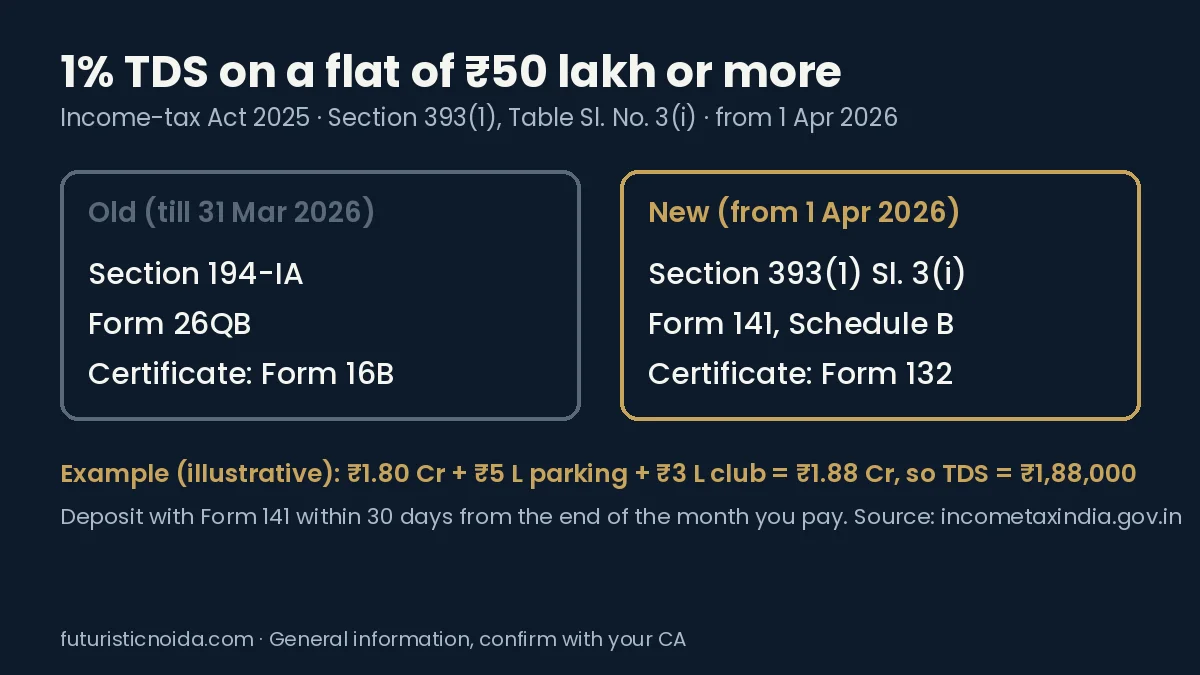
What changed on 1 April 2026
The Income-tax Act, 2025 replaced the 1961 Act. The department says there is broadly no change in TDS policy; the old sections are re-arranged into tables in Sections 392 and 393, with new form numbers. Any sum paid or credited on or before 31 March 2026 follows the old Act, and anything paid on or after 1 April 2026 follows the new one (transition FAQs).
| What | Till 31 Mar 2026 (1961 Act) | From 1 Apr 2026 (2025 Act) |
|---|---|---|
| The rule | Section 194-IA | Section 393(1), Table Sl. No. 3(i) |
| Form to pay and report | Form 26QB | Form 141, Schedule B |
| Certificate you give the seller | Form 16B | Form 132 |
| Where the seller sees the credit | Form 26AS / AIS | Form 168 (AIS) |
| Rate and threshold | 1% if price or stamp duty value is ₹50 lakh or more | Same: 1%, ₹50 lakh or more |
Sources: the department’s note on Form 141 (Form 141 replaces 26QB, 26QC, 26QD and 26QE; certificate in Form 132; credit in Form 168), Form 141 FAQs, Section 393 on the Income Tax Department site, the department’s Form 141 user manual and, for the old Form 26QB/16B process, the department’s Form 26QB/16B page.
Why this matters if you booked before April: on an under-construction flat booked in 2025, your early instalments went through 26QB and the later ones go through Form 141. Keep every 26QB acknowledgement. Schedule B of Form 141 asks whether a payment is a first, subsequent or last instalment and asks for the previous acknowledgement number (Form 141 itself (TRACES PDF)).
How the 1% is worked out on a ₹1.5 Cr+ flat
- Threshold: TDS applies if the price or the stamp duty value is ₹50 lakh or more. Once it applies, it is 1% of the whole amount, not just the part above ₹50 lakh (Income Tax Department TDS FAQs, Q15).
- Base: 1% of the price or the stamp duty value, whichever is higher (Section 393 on the Income Tax Department site). So compare your agreement value with the circle-rate value of the flat before the first payment; if the circle-rate value is higher (it can happen on resale deals), the 1% is on that. Check it with our circle rate guide.
- What counts as “price”: the 2025 Act says it includes club membership, car parking, electricity or water facility fees, maintenance fees, advance fees and similar charges linked to the transfer (Section 402(9) of the 2025 Act). The old Section 194-IA had the same list (Income Tax Dept guide to Section 194-IA). So the 1% is on the cost-sheet total, not just the basic price.
- Joint buyers or sellers: the ₹50 lakh test is on the total for the property, not each person’s share (Section 393 on the Income Tax Department site, Note 1). Splitting the flat between husband and wife doesn’t take you below the threshold. In Form 141, the department’s Form 141 user manual says to enter the full stamp duty value and the full price, not your proportionate share.
| Line in the cost sheet (illustrative) | Amount | In the 1% base? |
|---|---|---|
| Basic price | ₹1,80,00,000 | Yes |
| Car parking | ₹5,00,000 | Yes (car parking fee is named in the Act) |
| Club membership | ₹3,00,000 | Yes (club membership fee is named in the Act) |
| Total consideration | ₹1,88,00,000 | TDS = ₹1,88,000 |
| GST billed separately | 5% of the taxable value | Not spelled out in the TDS table. Agree it with your CA and the builder in writing |
Illustrative figures, not a quote for any project. For stamp duty and registration on top, use our ₹1.5–5 Cr stamp duty table and the GST guide.
Under-construction: you deduct on every instalment
TDS is deducted when you pay (or when the amount is credited to the seller, if that comes first), so every builder demand you pay carries its own 1% (Income Tax Department TDS FAQs). One Form 141 can cover several payments of the same type made in the same month, but payments made in different months need separate forms (Form 141 FAQs, Q14).
Take a 20:80 plan, where you pay 20% now and 80% at possession. Our Arihant One page lists one on its 4 BHK, as stated by the builder. On the same illustrative ₹1.88 Cr:
| Payment (20:80 plan, same ₹1.88 Cr) | You pay the builder | You deduct and deposit (1%) | Form 141 filings |
|---|---|---|---|
| 20% at booking / agreement | ₹37,22,400 | ₹37,600 | 1, in the month after you pay |
| 80% on possession | ₹1,48,89,600 | ₹1,50,400 | 1, in the month after you pay |
| Total | ₹1,86,12,000 | ₹1,88,000 | 2 |
“You pay the builder” = the instalment minus the 1% you deduct. Construction-linked plans mean many more filings. See construction-linked vs possession-linked.
Three things to settle before the first cheque:
- Is the demand letter net of TDS? If it asks for 100%, ask the builder in writing how they will credit the 1% you deposit. Otherwise your account can show a 1% shortfall at possession.
- Home loan disbursals. When the bank pays the builder directly, the TDS on that payment is still your job. Plan to pay the 1% from your own money in the same month, and tell the builder the acknowledgement number. Our tripartite agreement guide covers the bank’s side.
- Joint buyers file separately. If you and your spouse are co-buyers, each of you files your own Form 141 for your own share of each payment (Form 141 FAQs, Q15). See joint home loan with your wife.
Deadlines and what late costs
- Deposit and file: within 30 days from the end of the month you deducted. If you pay the builder on 10 Nov 2026, Form 141 and the tax are due by 30 Dec 2026 (the department’s note on Form 141).
- Certificate to the seller: download Form 132 from TRACES and give it to the seller within 15 days of that due date (the department’s note on Form 141).
- Interest (Section 398): 1% a month or part of a month if you don’t deduct, and 1.5% a month or part of a month if you deduct but deposit late (Income Tax Department TDS FAQs, Q5). On the ₹1,50,400 possession-stage TDS above, each month of late deposit costs about ₹2,256.
- Late filing fee under Section 427, and a possible penalty equal to the tax not deducted or paid under Section 448 (Form 141 FAQs, Q21; Income Tax Department TDS FAQs, Q5). If you make a mistake, you can correct the form within 2 years from the end of the tax year (Form 141 FAQs, Q19).
- Seller’s PAN: if the seller’s PAN isn’t given, the rate goes up to at least 20% (Section 397(2)(a), Income Tax Department TDS FAQs, Q11). Copy the PAN from the seller’s own card into your file before you pay.
How to file Form 141 (Schedule B), step by step
- Log in to the Income Tax e-Filing portal with your PAN and go to e-Pay Tax (the department’s note on Form 141).
- Choose Form 141, Schedule B: transfer of immovable property.
- Have these ready: the address of the property; PAN, name, phone and email of every buyer and seller with their % shares; the agreement date; the registration date (if registered); the total stamp duty value; the total price; and whether this is a lump sum or a first, subsequent or last instalment (Form 141 itself (TRACES PDF)).
- Pay the TDS online in the same flow. You get an acknowledgement (ARN) and a challan number (CIN) (Form 141 FAQs, Q17, Q18, Q27).
- When it’s processed, download Form 132 from TRACES and send it to the seller. The seller sees the credit in their Form 168 (AIS) (the department’s note on Form 141).
Resale and NRI sellers: different rules
Everything above is for a resident seller. If the seller is an NRI, Section 393(1) doesn’t apply. TDS then falls under Section 393(2), Table Sl. No. 17, at non-resident rates. For long-term gains the department’s rate table shows 12.5% plus surcharge and cess (Income Tax Department TDS FAQs, Q2, Q15, Q17). From 1 Oct 2026 a resident individual or HUF buying from an NRI doesn’t need a TAN for this (Income Tax Department TDS FAQs, Q16). Read our NRI TDS guide before you agree a price. If the NRI seller wants TDS only on the gain, they need a lower-deduction certificate before the registry, and that takes time. For any resale, also run the resale documents checklist and check transfer charges.
If you’re looking at resale in Greater Noida West at this budget, we currently have a few Stellar One resale flats at about ₹10K/sq ft all-inclusive*. The same 1% TDS applies to the resident seller, and you file it the same way.
My checklist before you sign
- Write the seller’s PAN, the stamp duty value and the full cost-sheet total on one page. That’s your 1% base.
- Ask the builder in writing whether demand letters are net of TDS and how they credit it.
- Diarise the 30-day deadline after each payment month, and keep every ARN, CIN and Form 132 in one folder. You’ll need them at possession and at resale.
- Download our free PDF guides (the documents checklist and the under-construction vs ready-to-move guide) and read hidden charges before you compare quotes.
Related: home loan tax benefit on an under-construction flat · registry process step by step · down-payment budget · SOBHA Rivana · Stellar One.
Sources (checked 3 Nov 2026): Section 393 on the Income Tax Department site; Income Tax Department TDS FAQs; the department’s note on Form 141; Form 141 FAQs; Form 141 itself (TRACES PDF); Form 141 user manual; the department’s Form 26QB/16B page; Income Tax Dept guide to Section 194-IA; Income Tax Department transition FAQs; Section 402(9) of the 2025 Act. *Stellar One resale price is our channel information, indicative only; confirm on call. Tax rules: confirm with your CA before you pay.
Disclosure: Futuristic Noida (Rohit Kumar Jha) is a RERA-registered channel partner for Godrej, Sobha, Stellar and Prestige projects and may earn brokerage from the developer on bookings made through us; this does not change your price. Gains (if any) depend on the market. Images marked "Artistic impression" are not photographs.
General information, not legal, tax or financial advice. Rules change; confirm with a lawyer/CA and the official portal before you pay. No returns are promised.
A decade in real estate, including my years at 99acres. Send the document, I'll tell you straight. WhatsApp 9953793147 Request a call-back
FAQ
Is Form 26QB still used for TDS on property purchase in 2026?
Only for payments made or credited on or before 31 March 2026. From 1 April 2026, TDS on buying property from a resident seller is deposited with Form 141, Schedule B, under Section 393(1), Table Sl. No. 3(i) of the Income-tax Act, 2025.
How much TDS do I deduct when I buy a ₹1.5 crore flat in Noida?
1% of the price or the stamp duty value, whichever is higher, on the whole amount. On ₹1.5 Cr that is ₹1.5 lakh. The price includes parking, club membership and similar charges, and you deduct it from each payment.
Do I need a TAN to deduct TDS on a flat purchase?
No. For a resident seller you file Form 141 with your PAN. From 1 October 2026, a resident individual or HUF buying from an NRI seller also doesn’t need a TAN, but different rates apply under Section 393(2).
What is the due date for Form 141?
Within 30 days from the end of the month in which you deducted the tax. For a payment on 10 November 2026, the due date is 30 December 2026.
What happens if I pay the TDS late?
Interest under Section 398: 1% a month if you didn’t deduct, and 1.5% a month if you deducted but deposited late, plus a late fee under Section 427 and a possible penalty.
← All blog posts · Projects · RERA approved projects · Godrej DMIC Greater Noida · New launches in Noida · Contact